9 Ways to Stop Being Upset by Others!

Commit these nine observations to memory; accept them as gifts from the Muses; and while you still have life, begin to live...

The Emperor's Handbook 11:18

I keep track of my thoughts about Stoicism in a notebook that I try to keep near me. Most of its pages are incoherent; containing scattered musings from recent readings or reminders to revisit some chapter or other when I get the chance. From time to time, however, a Stoic author lays out an idea in such a succinct manner that the notes I create from it are practical. Book 11, Chapter 18 of Aurelius' Meditations is just such a usable bit of writing.
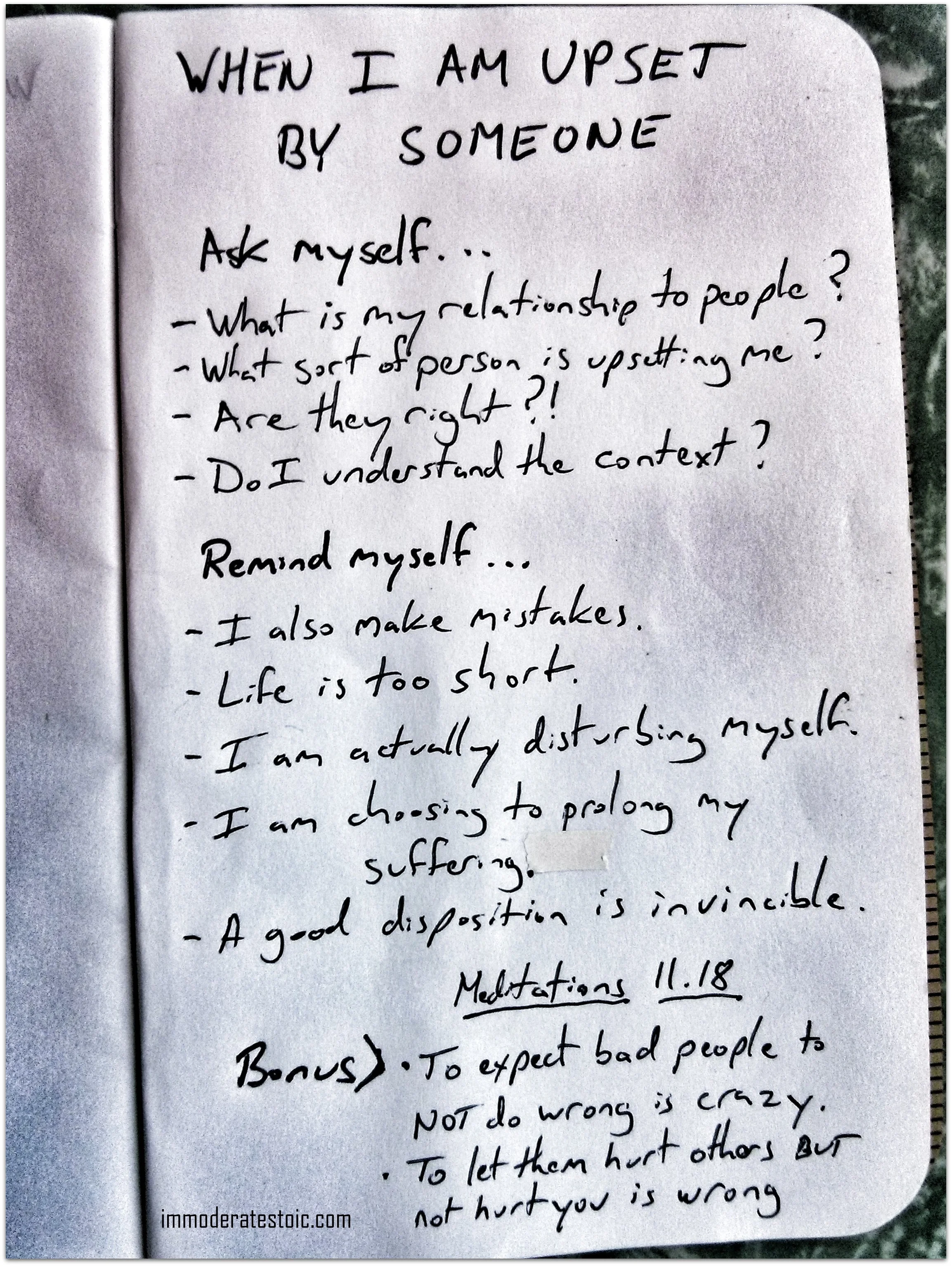
A page from Matt Van Natta's notebook. Points derived from Marcus Aurelius' Meditations, 11.18.

A page from Matt Van Natta's notebook. Points derived from Marcus Aurelius' Meditations, 11.18.

These four questions and five reminders are a certain means of regaining a Stoic mindset if we are set off balance by the day's social interactions. Of course, in order for them to be effective, we need a clear understanding of the worldview that informs the exercise.

  •  What is my relationship to others?

Marcus Aurelius' short answer is, "we are made for each other." The Stoic view is that our highest purpose is fulfilled by serving others. We should seek to do right by everyone we meet, even if they are not returning the favor.

  • What sort of person is upsetting me?

Evaluate the person you're dealing with. Aurelius breaks this down into sub-questions: What actions do their opinions compel them to perform and to what extent are their actions motivated by pride? Stoics never expect people with bad information to make good decisions.

  • Are they right?!

Check yourself. You could be the one that's in the wrong. Never forget that you are fallible.

  • Do I understand the context?

Aurelius reminds us that, "Many things are done for reasons that are not apparent. A man must know a great deal before condemning another person's behavior." Looking back to the question "are they right," the Stoic default position is, "I don't know." It's difficult enough to keep ourselves on a consistent path of virtue, why waste time guessing where someone else is at?

  • I also make mistakes.

If we expect any grace from others when we stumble, shouldn't we be willing to give the same to them?

  • Life is too short.

"Think...how soon you and your vexations will be laid in the grave." Aurelius didn't want to spend his time angry and impatient when he could, instead, pursue happiness. It's sound advice.

  • I am actually disturbing myself.

Stoics hold ourselves responsible for our emotions. As Epictetus put it, "it is not circumstances themselves that trouble people, but their judgement about those circumstances." It's important to realize that we can't control how others act, but we can choose how we will respond. Aurelius reminds himself that, "it isn't what others do that troubles you. That is on their own consciences. You are bothered by your opinions of what they do. Rid yourself of those opinions and stop assuming the worst - then your troubles will go away. How do you get rid of your opinions? By reminding yourself that you aren't disgraced by what others do."

  • I am choosing to prolong my suffering.

"Our rage and lamentations do us more harm than whatever caused our anger and grief in the first place." Again Aurelius lays bare the ridiculousness of fuming about another person's actions.

  • A good disposition is invincible.

"What can the most insolent man do if you remain relentlessly kind and, given the opportunity, counsel him calmly and gently even while he's trying to harm you?" I sort of love the term "relentlessly kind." If we succeed at keeping a Stoic mindset during every social interaction, then we will genuinely value each and every person we meet. This would have to be unnerving! I'm picturing a salesperson who is speaking nicely but seems to have spite behind their eyes. However, Aurelius isn't counseling a faux friendliness. In fact, he continues, "Let their be nothing ironic or scolding in your tone, but speak with true affection and with no residue of resentment in your heart. Don't lecture him. Don't embarrass him in front of others. But address him privately even if others are present."

We're not going to run out of situations that make these points useful. Emperor Aurelius advised himself to memorize them. You may want to as well. Or, like me, you might choose to carry a reminder with you. I know that when I turn to the nine points of Meditations 11:18, I find it impossible to continue stoking the anger that's in me. I'm reminded of the practical outcomes that are expected from a lived Stoic philosophy. I realize that if I truly believe that all people have value and that we are meant to work together, I can not act against that truth and consider myself reasonable. I suspect that taking a page from Aurelius will work as well for you.


All Aurelius quotes from The Emperor's Handbook, a new translation of the Meditations.

Stoic Parenting: Praise the Process

There's a growing body of evidence that praising children for attributes like intelligence or athletic ability backfires as a means of promoting achievement. Well meant praise can often send a message to a child that certain aspects of their life are fixed ("I'm smart at this, but I'm dumb at that."), as pointed out in an article on the KQED MInd/Shift blog. If a child internalizes the belief that they are either naturally good at something or not, it undermines the determination that is necessary to learn, grow, and eventually master a skill. Thankfully, Stoicism offers a perspective and some exercises that complement these findings so that our own children avoid the pitfalls of such a poor perspective.

What we've shown is that when you praise someone, say, ‘You’re smart at this,’ the next time they struggle, they think they’re not. It’s really about praising the process they engage in, not how smart they are or how good they are at it, but taking on difficulty, trying many different strategies, sticking to it and achieving over time.

-Carol Dweck, professor of psychology at Stanford

Professor Dweck's research shows that praise should be directed at the process of learning, rather than focused on the outcome. Pat your child on the back for engagement with a subject. Encourage their efforts to avoid frustration as they run into, then overcome, obstacles. Remind them that failure is a part of learning and then help them devise new strategies for success. Don't simply proclaim, "you got the right answer, good job" and definitely don't say, "you're such a smart kid" and call it a day. 

Historically, Stoicism has frowned on praising people. For instance, here's Epictetus' definition of a person succeeding at Stoicism,

The marks of a proficient are, that he censures no one, praises no one, blames no one, accuses no one, says nothing concerning himself as being anybody, or knowing anything: when he is, in any instance, hindered or restrained, he accuses himself; and, if he is praised, he secretly laughs at the person who praises him; and, if he is censured, he makes no defense.

Enchiridion Chapter 48

To the ancient Stoics, praise had no utility. In book four of his Meditations, Marcus Aurelius put it this way, "Everything which is in any way beautiful is beautiful in itself, and terminates in itself, not having praise as part of itself... [What] is beautiful because it is praised, or spoiled by being blamed?" Of course, in the Roman court the praises Marcus overheard were not only useless, they were manipulative. Praise was politics, meant to sway people one way or the other. Parental praise, we can hope, is at least well meant but as we've seen, praise of the wrong type can be damaging.

The Praise the Process perspective actually fits easily within the Stoic framework. In book ten of the Meditations, Aurelius makes a rare positive comment concerning praise, "...a man becomes both better, if one may say so, and more worthy of praise by making a right use of these accidents." The "accidents" Marcus mentions are the misfortunes of life. What is the Emperor willing to praise? A person's ability to make good use of circumstances. He won't congratulate you on your 'natural' intelligence, strength, or beauty, but he'll applaud your wise actions. Wisdom, for Stoics, is not a internal trait of which you have a set amount, it is the manner in which you approach the circumstances of life. Wisdom is the process of living well. It's worth praising that process.

So, outside of praising the process, what specific Stoic exercises can we parents use with our children to build some grit and determination into their perspectives? 

Allow not sleep to close your wearied eyes,
Until you have reckoned up each daytime deed:
‘Where did I go wrong? What did I do? And what duty’s left undone?’
From first to last review your acts and then
Reprove yourself for wretched [or cowardly] acts, but rejoice in those done well.

Epictetus' Discourses 3.10.2-3

The above quote supports a Stoic practice called the Evening (or Retrospective) Meditation. Many of us go through this process nightly before bed. I'd like to suggest bringing this meditation to the family dinner table.

The  Evening Meditation consists of reviewing three questions; What did I do today? What did I do amiss? What was left undone? The final paragraph of the KQED article says that Professor Dweck, "believes families should sit around the dinner table discussing the day’s struggles and new strategies for attacking the problem. In life no one can be perfect, and learning to view little failures as learning experiences, or opportunities to grow could be the most valuable lesson of all." As Stoic parents, we can practice this idea and grow in our philosophy while doing so. I suggest that as we gather our family around a meal, where we probably already ask, "what did you do today?" we add the questions, "What did you succeed at and struggle with today?" and "What needs to be done tomorrow?" We can share in the triumphs of our children's day. We can share our own challenges so that our children understand that struggle is to be expected. We can plan together, as a family, our strategies to overcome obstacles big and small. In doing so, we build an understanding of, and appreciation for, the process of learning in our children (and ourselves) and they will be stronger for it.

Praise matters. Children need feedback to help them understand the world around them. Research shows that how we praise others is important. Like the ancient Stoics, we can choose to praise those things that lead to wisdom and, in doing so, we will help our children thrive.


UPDATE: Ben Butina at Approximately Forever posted about similar issues, particularly how best to promote moral actions in children. Be sure to read his article as well.

Loomio: A Voice for Everyone

Your only joy, and your only rest, is to pass from one action performed in the service of the human community to another action performed in the service of the human community...

Aurelius VI, 7

Check out the crowdfunding campaign: http://love.loomio.org

Today I'm going to talk about Loomio, a platform for cooperative decision making. What's Loomio have to do with Stoicism? Well...it is the duty of every Stoic to work towards a just society. The Stoic perspective is a communal one, as I've previously stated. Other than that, I just happen to be deeply interested in technology that promotes cooperation. Loomio does just that, and it's in the last weeks of funding. So here's my personal pitch.

Loomio is a means of making democratic, all voices included, collaborative decision-making fully scalable. The platform allows people to come together for productive problem-solving conversations where every voice is heard and all ideas can be on the table. With Loomio, people anywhere can self-organize and solve the issues that matter to them. That's what I mean by "scalable." Until now, real democratic decision-making has required small groups in face to face circumstances. Now that same process simply requires a mobile phone*.

Why am I excited about Loomio? I work in emergency management. When I was managing a New York shelter during Hurricane Sandy, the hardest thing to do was solicit ideas from our clients. They were the ones who knew what worked and what didn't. They had ideas as to how to make things better. Getting those ideas heard was the challenge. What if every person in that shelter could easily communicate their thoughts, and the best ideas rose to the top of the conversation? It would have been amazing.

All across this world people are being displaced by violence and other disasters and forced over borders into makeshift camps. What if within days of a camp forming, the people could self-organize to solve problems and also magnify their voices in the face of the international organizations that arrive to bring aid? It could change the face of community agency.

And yes, Loomio could also make organizing a local block party all the simpler.

Here's a few final points about Loomio, it's:

  • mobile, so it works across all devices
  • safe, so you can control your own data and privacy
  • accessible, so people of all abilities can participate
  • free and open-source software, licensed under AGPL3
  • as easy to use as email

If you look into Loomio and find it at all intriguing, please think about donating and spreading the word. If it doesn't mean much to you, but you have friends or followers who are interested in community organization, grassroots democracy, or who volunteer for international NGOs, pass the word to them. Loomio is an experiment worth supporting.

Thank you,

Matt

*Please don't think that 'mobile phone" means that Loomio is for the wealthy. Most so-called developing nations have mobile penetration levels significantly higher than the "developed" world. In fact, many have penetration beyond 100% (more mobiles than people). Also, Loomio is striving to work through SMS, so users won't even require a smart phone.